A First Chamber Concert, Heard One Instrument at a Time
First chamber concert listening becomes easier when you hear how a musical idea changes hands, even if you do not know the piece or its form.
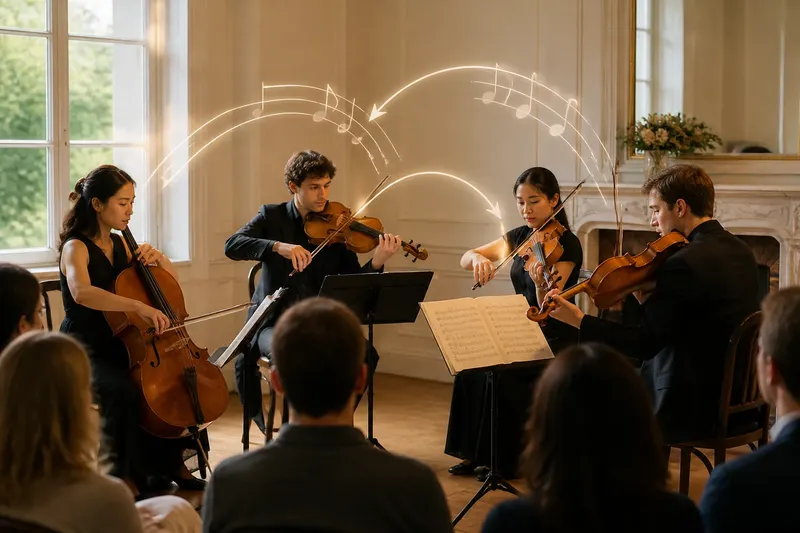
The common mistake at a first chamber concert is trying to identify every instrument and follow every line at once. The cost is immediate: the music turns into a blur, and attention gets spent on sorting sounds instead of hearing what the ensemble is doing. For a clearer first chamber concert, listen for how a musical idea changes hands.
Listen for musical handoffs
Chamber music often lets a phrase pass between players, change shape, or return after a pause. Rather than tracking one instrument throughout, listen for the idea itself: a rising figure, a clipped rhythm, or a short melody that reappears in a different voice.
Notice what happens to the idea as it moves. Another player may repeat its contour at a higher pitch, answer with a contrasting rhythm, or support it with a steady pattern. You do not need to identify every note to hear that the relationship has changed.
In a string quartet, a phrase may begin in the cello and reappear in the violin while the viola supplies a regular pulse. The useful question is not which player has the leading role, but how the ensemble has redistributed the musical material.
Recognize a phrase
A musical idea can be easier to recognize by its shape than by its exact pitches. Listen for a line that rises and falls, a repeated note, a rhythm with a distinctive pause, or a phrase that ends with a held sound.
These clues work across changes in timbre. A clarinet and violin may sound very different, yet both can present a similar rising contour. If you hear a familiar shape in a new instrument, the phrase may have been passed along or transformed.
Do not worry if you cannot tell whether two passages are precisely the same. A resemblance is enough to make the exchange audible.
Hear roles change
In chamber music, a player’s part can shift between melody, accompaniment, pulse, and response. A tune may move into the background while the instrument that carried it begins supplying short, regular notes beneath another player’s line.
Listen for the texture around that change. A held note can anchor moving parts; a repeated figure can keep the music in motion; a brief silence can make the next entrance feel newly prominent. These roles help explain how the ensemble fits together without requiring a formal analysis.
Imagine a quartet begins with a rising cello figure. The first violin then repeats its contour at a higher pitch, while the viola maintains a steady pulse and the cello shifts to longer notes. The result is an audible handoff: the phrase has moved, and the original player now supports the texture.
Use the room sparingly
Watching the players can help clarify an entrance, especially when a sound is difficult to identify. A breath before a wind player begins or a lifted bow before a string player joins may point your ear toward the new line.
Keep your attention on the sound rather than trying to read every gesture. Players also move to coordinate, and not every visible motion marks a new musical event.
A brief glance is enough; return to listening when the phrase begins.
Prepare without homework
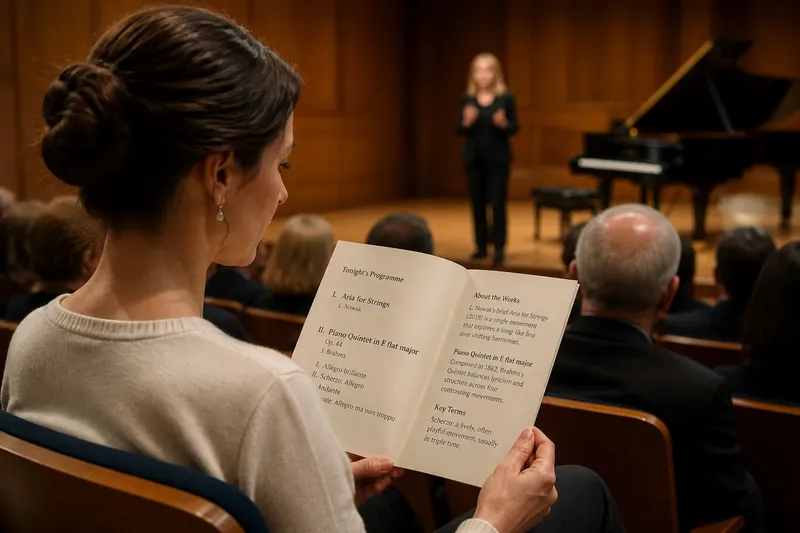
A programme can tell you the instrumentation and the names of the pieces, which may help you recognize the players. Notes about form or musical history can add context, but they are not required for hearing a phrase repeat or change hands.
If the texture becomes crowded, wait for a pause, a repeated rhythm, or a clear entrance. Start listening again there rather than trying to reconstruct what you missed.
Before the music begins, you can keep a few simple questions in mind:
- What short rhythm or contour has returned?
- Does the idea sound familiar in a different instrument?
- Has a player moved from melody to accompaniment?
- What does the ensemble do during a pause?
- Which sound makes the next entrance easiest to hear?
Questions about listening?
Do I need to know the piece beforehand?
No. Repeated shapes, pauses, and changes in texture are audible without knowing the title or formal structure. Programme notes can add context, but prior study is optional.
What if I cannot identify the instruments?
Listen for a sound’s register, rhythm, or contour instead of naming its source. A low sustained line or a repeated short figure can be followed even when the instrument remains unclear.
Should I focus on the melody?
The melody can be a useful entry point, but it may pass to another player or pause while accompaniment comes forward. Listening for repeated rhythms and phrase shapes can reveal those changes.
What if I lose track of the music?
Wait for a clear entrance, a pause, or a familiar pattern, then begin listening from there. You do not need to recover every missed detail to hear what happens next.
Let ideas travel
At a first chamber concert, the aim is not to separate the music into individual parts. Hearing a phrase return in a new voice can make the ensemble’s shared work clear: one player introduces an idea, another alters it, and the surrounding parts change their roles.
For first chamber concert listening, keep the focus on that movement of ideas rather than on identifying every note. Even one audible handoff can make the music easier to follow, while leaving plenty of room for the parts you did not anticipate.