Before the Applause, How Concerts Found Their Order
Concert programme history shows how running order can shape a concert, and offers practical ways to hear contrasts, transitions, and the choices behind a sequence.
The common mistake is to treat a concert programme as a neutral list: works appear in sequence, performers play them, and the audience listens. Concert programme history shows why order deserves attention: a mixed bill and a focused recital make different demands on listeners, even when both fit on one page.
Mixed bills and occasions
There is no single early concert format to recover from a bare list of works. Public musical gatherings could combine music with spoken material or other attractions, and their shape depended on the venue, performers, patrons, and local practices. Without a dated programme or other evidence, it is safer to describe the range of possible formats than to claim a universal progression.
In a mixed bill, variety could be part of the occasion rather than a flaw in its design. A change of musical character might refresh attention or accommodate different performers. The list could also serve as a record of what was offered, without promising one continuous musical argument.
When a surviving programme gives only titles and names, it does not reveal every pause, change, or decision made in the room. Read what the document actually records, and leave unrecorded details open.
Order and practicalities
A sequence shapes expectations before the first note. A short opening item may invite attention; a contrasting middle work can change the evening’s texture; a final piece may feel like a culmination or simply mark the end. These are possible effects, not proof of what an organizer intended.
Order also has practical consequences. Performers may need time to change instruments or rearrange chairs, while a different combination of players can require a stage reset. A pause can serve those needs and give listeners a chance to adjust their attention.
Artistic and logistical choices can overlap. Describe the audible effect of a transition before attributing a private motive to the people who planned it.
Focused evenings and recitals
Some concert formats center attention on a work, a group of works, or a performer. In a recital, the performer can become a point of continuity across separate pieces; in a program grouped around a composer or ensemble, the connection may instead come from shared authorship or musical forces. The particulars vary by event, so a printed sequence alone cannot establish a single historical timeline.
A pairing may invite comparison through form, sound, or contrast, but a listener need not accept one prescribed interpretation. The connection might be audible, faint, or overshadowed by the differences between the pieces. Either response is more precise than assuming the printed order has one hidden meaning.
Concert formats can mix these approaches. A focused sequence and a deliberately varied bill both involve choices; they simply direct attention toward different relationships.
Who shapes a sequence
Performers, organizers, venue staff, and patrons may all influence an event’s order, though their roles depend on the occasion. A soloist might choose a recital sequence, while a larger event has to coordinate an ensemble, guest performers, and stage arrangements.
Available players, instrument changes, audience expectations, and venue conventions can narrow the options. A programme can therefore hint at the conditions of an event, but it rarely identifies every person or reason behind a placement. When evidence is limited, distinguish what the sequence does from what you can only guess it was meant to do.
Reading concert order?
What should I notice first?
Mark the opening, the largest change in performers or sound, and the final work. Those points give you a simple structure to compare with what you hear.
Does a shared composer explain a pairing?
It gives you one connection to listen for, not a complete explanation. Notice whether the works also differ in scale, texture, or mood.
What if the order feels disconnected?
Record the contrast rather than forcing a narrative onto it. The sequence may be offering variety, or practical needs may have shaped the placement.
Can the printed list reveal the organizer’s intention?
Not by itself. A programme records an order, while notes, correspondence, or other documents may be needed to support a claim about why it was chosen.
A worked listening example
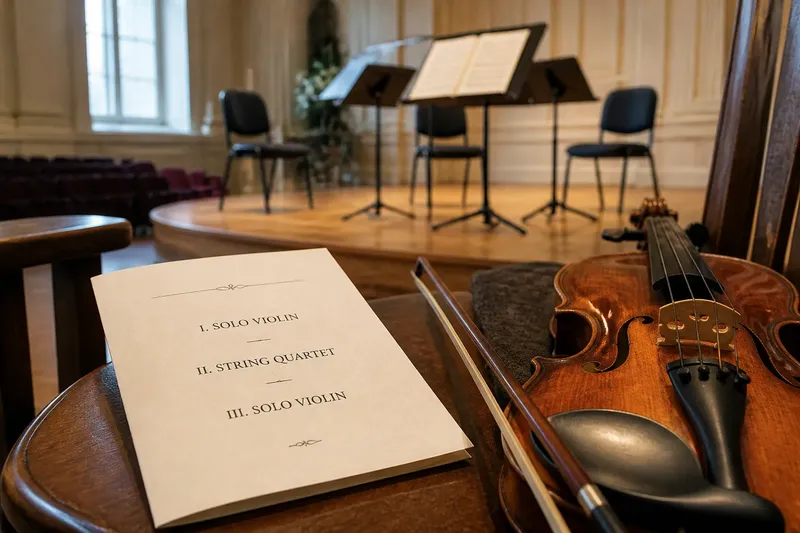
Say you attend an invented chamber concert whose programme lists, in order, a solo violin work, a string quartet, and a second solo violin work. Treat those titles and forces as hypothetical inputs, not as a record of an actual concert.
Before the music, note the observable change from solo violin to four players and back. During the first transition, listen for how the quartet changes texture and volume; during the second, notice whether returning to one instrument feels like a contrast or a continuation. Afterward, write down which effect you actually heard.
If the opening and closing solo works share a noticeable character, you might describe them as a frame around the quartet. If they sound unlike each other, record the contrast instead; if the connection remains unclear, leave the sequence as three distinct items. Each answer follows from the listening, not from an assumed plan.
What order makes possible
Concert programme history is most useful when it keeps claims tied to evidence. A dated list can show what was scheduled; a fuller document may add notes or other context; neither automatically reveals how every listener experienced the event.
- If the programme lists several kinds of entertainment, describe the bill as mixed; if it lists music alone, do not assume other attractions were present.
- If two works share a composer, listen for audible similarities; if none stand out, treat authorship as context rather than proof of a musical link.
- If the forces change between works, notice the shift in texture; if they remain the same, listen instead for changes in form or character.
- If the programme marks a pause, use it to reset your attention; if it does not, avoid inferring that the event had no break.
- If a performer returns later in the sequence, compare the musical effect of that return; if no performer recurs, focus on the contrast between groups or works.
- If notes explain a pairing, test that suggestion against the sound; if the connection is not audible to you, keep the note as one interpretation rather than a verdict.
For your next concert, write down one transition and the change you heard in it. That small record is more useful than a guessed story about why the sequence was chosen.